
Despite the benefits of hybrid technology, a lack of government backing and few launches have kept the segment from gaining ground.

Maruti Suzuki is planning a further investment of Rs 9000 crore in India for world class R&D centres, design facility, regional distribution centres and logistics support. The fresh investment will be made over a longer period, about eight years, as compared with three years for some earlier investments. Regional warehouses will cut short the delivery time of vehicles. The centralised and timely despatch of vehicles from its facilities in the north will mean faster shipment.
Production has not started yet, but there are indications that it will resume today with alternate arrangements like contract workers and hiring technicians.

Developed in-house, the 1.5-litre engine comes mated with six-speed transmission and offers improved performance.

Practice of opening bookings for cars prior to launch has been followed by several companies over many years in India.

From the 30 Sensex companies, Zomato, Tata Motors, IndusInd Bank, Asian Paints, Bajaj Finance, Maruti Suzuki India, Adani Ports, Hindustan Unilever, Reliance Industries, Bajaj Finserv, UltraTech Cement and Infosys were among the laggards. In contrast, State Bank of India, ICICI Bank, Tata Steel, NTPC, Tata Consultancy Services, PowerGrid, Kotak Mahindra Bank and Sun Pharmaceuticals were the gainers.

From the Sensex stocks, Maruti Suzuki India, Tata Motors, JSW Steel, Larsen & Toubro, Tata Steel, Mahindra and Mahindra, Tata Consultancy Services, Tech Mahindra, HCL Technologies and Infosys were the laggards. HDFC Bank, Sun Pharmaceuticals, Kotak Mahindra Bank, Nestle India and Asian Paints were among the gainers.
Maruti has rolled out the millionth unit of Alto, since its launch in Sept 2000.

Good sowing of kharif crops, better minimum support prices, and fewer Covid-19 cases (in villages) will help the rural growth story to continue, says Maruti.
Maruti Suzuki India, which last year dropped Udyog as its middle name and appointed its first Japanese managing director, has set up a new management structure installing five Indians in crucial decision-making positions. This layer forms the second rung of the company's executive management, just below managing director S Nakanishi. Earlier, when Jagdish Khattar was the managing director, he was the only Indian in the top management.
Maruti Suzuki's announcement that a proposed factory in Gujarat will be owned not by it but by a fully-owned subsidiary of Suzuki Motor Corporation gives rise to several questions related to corporate governance - and to larger questions about the regulation of multinationals in India.
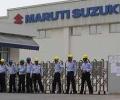
Hit by recurrent labour unrest at its Manesar unit in Haryana, Maruti Suzuki India Ltd (MSIL) on Thursday said the company would introspect on whether an affiliated union with a pro-business approach and mature leadership would benefit the company.
Maruti Suzuki India growing by a paltry two per cent in January, recorded the lowest growth in this financial year, which could be due to the launch of Tata's Nano.

A group of casual workers have been sitting in front of the Manesar plant, asking the company to let them rejoin work.
The unit has a manufacturing capacity of 700,000 cars in two shifts. This means the Japanese major is cutting production by 35,000 cars as higher loan rates and a slowing economy sapped demand for automobiles. Sales at Maruti, 54 per cent owned by Suzuki, fell 7 per cent in October. India is the biggest global market for Suzuki, Japan's second-largest minicar maker.
The country's largest car maker Maruti Suzuki India on Tuesday reached a wage settlement agreement with its workers at its Gurgaon plant, under which the employees will get an average salary hike of Rs 18,000 per month spread over three years.
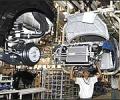
In the last two days, the company had done the ground work for resumption of work in the press, weld and paint shops by bringing in additional workers.
Will sign agreement with vendors to make sure indigenisation takes place within given timeframe.

Jimny will be priced between Rs 12.7 lakh and Rs 15.05 lakh.

The company, which sells every second car in the domestic market, said it expected production and sales to grow between 4 per cent and 8 per cent for the financial year started in April.
Maruti Suzuki India on Tuesday reopened its Manesar plant amid heavy security, a month after a lockout was declared due to the violence in which one senior company official was killed and 100 others injured.
Rs 15,000-cr investment planned to protect vendors from rising realty prices
Shows i10 in poor light two weeks after Hyundai took swipes at Ritz.

Passenger vehicle wholesales saw a marginal growth of 4 per cent in June on account of high base effect and muted demand due to severe heatwave conditions in several parts of the country. Overall passenger vehicle dispatches last month stood at 340,784 units, a growth of 3.67 per cent compared with 328,710 units in June 2023.

According to experts, even if an additional 5 per cent of people opt to buy new vehicles, it may bring a huge boost to the sector.

Under the campaign --'Beat The Heat', the company will also offer free top wash, TrueValue evaluation and exchange.

From the Sensex pack, Tata Consultancy Services, Mahindra & Mahindra, ICICI Bank, Maruti Suzuki India, Power Grid, Axis Bank and Adani Ports & Special Economic Zones were among the laggards. On the other hand, HCL Technologies, Tech Mahindra, JSW Steel, Hindustan Unilever, Infosys and Titan were among the gainers.

Maruti is trying to move up the segment by focusing on premium cars, SUVs and even trucks.

MSI exported 70,023 units in the 2008-09 fiscal.

Hyundai Motor India Ltd, the Indian arm of South Korean automaker Hyundai, has received capital markets regulator Sebi's approval to float an initial public offering (IPO), people familiar with the development said on Wednesday. This development marks a significant milestone for the Indian industry, as it is the first automaker initial share-sale in over two decades, following Japanese automaker Maruti Suzuki's listing in 2003.

Hyundai Motor India and Honda Cars India on Wednesday joined the list of automakers planning to hike prices of vehicles from April, second time this year, to partially offset the impact of rising input costs and higher operational expenses. In a statement Hyundai Motor India Ltd (HMIL) said it will hike prices of its vehicles by up to 3 per cent effective in April 2025.
Khattar's place will be taken by Shinzo Nakanishi, who is currently the chairman of MSIL. R C Bhargava, who is a director, has been named the new chairman.

The country's largest car maker Maruti Suzuki India (MSI) on Thursday said it is considering increasing prices of its products from next week to offset the impact of rupee depreciation.
The company said sales of the compact segment comprising Swift, Estilo, Ritz surged over two fold to 17,409 units
Japanese manufacturer Suzuki displayed two cars at the Frankfurt Motor Show that have a huge potential for launch in India.
As rivals gain ground, the market share of the country's largest car-maker, Maruti Suzuki India, continues to hover below the 50 per cent mark, despite the firm posting its best-ever monthly domestic sales in July.
The latest round of violence in Manesar brings into sharp focus how Maruti could have done better in terms of industrial relations management.
The labour unrest at Maruti Suzuki India's Manesar plant took a violent turn on Thursday when a group of supervisors were attacked on their way to work, with five of them sustaining injuries.
Car market leader Maruti Suzuki India on Monday reported 24.1 per cent increase in net profit for the quarter ended December 31, 2007, at Rs 467 crore (Rs 4.67 billion).

Still recovering from the impact of workers' violence in July at the Manesar plant, the company also said it is looking at 10 per cent increase in overall production this fiscal.
